I currently work in the computational neuroscience lab of Francis Crick Chair Professor Terry Sejnowski
at the Salk Institute.
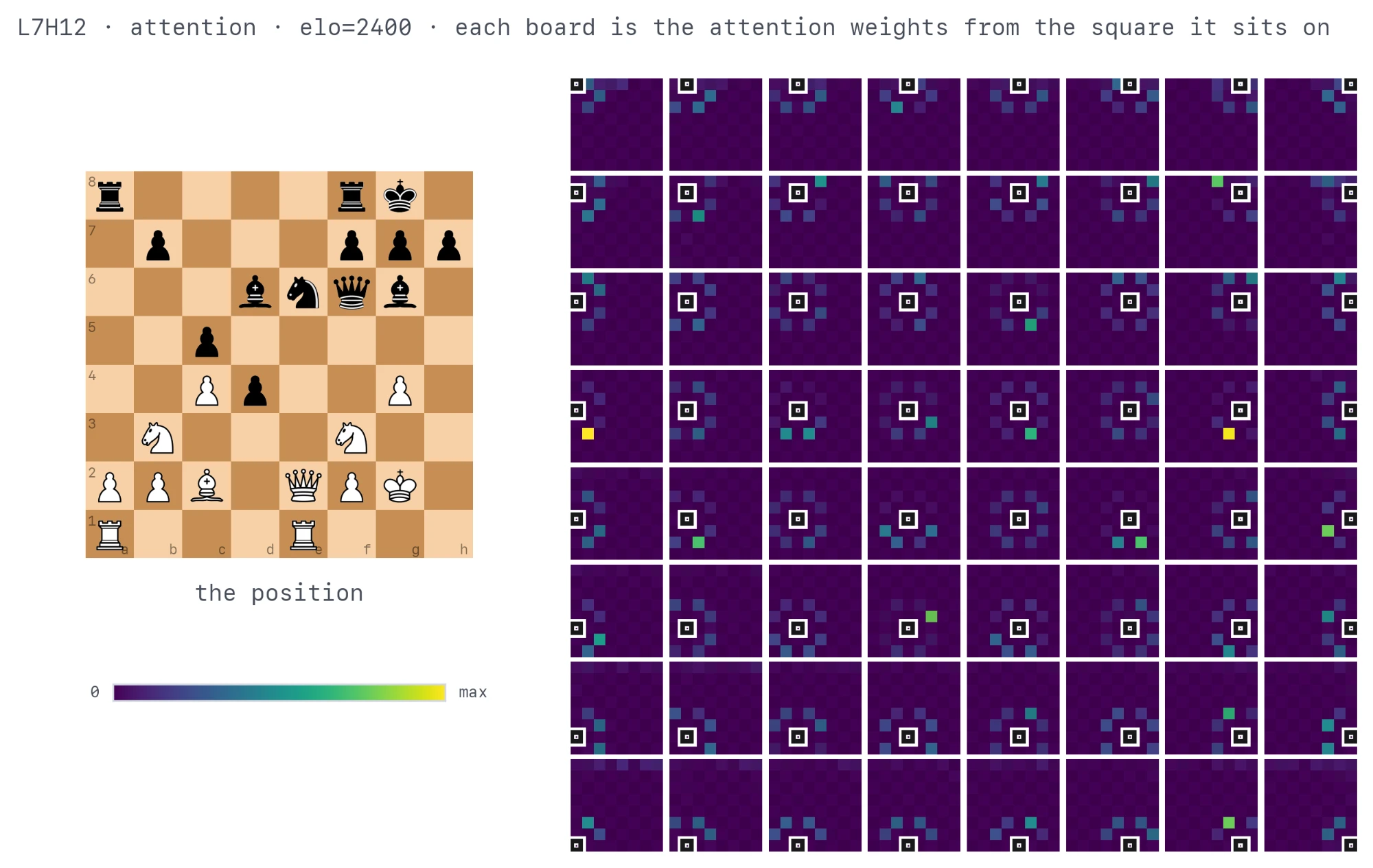
Right now I am investigating the internal ontologies of transformer-based chess engines. My current
focus is Maia-3, which takes Elo (the standard metric for chess skill) as an
input to the pre-trained network, so you can vary the skill the network is conditioned on with no
change to its weights. Turning that Elo dial up from 700 to 2500:
Pushes the computation deeper, monotonically, for every chess piece and move type I measured.
This "depth migration" happens most for specific tactics, especially knight forks.
The mechanism appears to consist of deeper (later) heads getting recruited for more specialized
computations while shallow (earlier) heads keep a roughly constant contribution.
I spent a year running clustering on behavioral and imaging data from the ABCD study to identify a
participant subgroup and investigate neural and genetic (GWAS) correlates. Publication upcoming as soon as final data set is released for research from NIH.
UCSB LEAP lab — emotional temporal coding
Contributed to a graduate student’s fMRI dissertation on emotional temporal coding, running
multivoxel pattern analysis (MVPA) and representational similarity analysis (RSA) with
region-of-interest masks in frontal pole and related areas (FSLeyes).
Recent books
Relevant to neuroscience
Projections Karl Deisseroth
I Am a Strange Loop Douglas Hofstadter
Being You: A New Science of Consciousness Anil Seth
ChatGPT and the Future of AI Terry Sejnowski
Neurophilosophy Patricia Churchland
A Brief History of Intelligence Max Bennett
The Neuroscience of Emotion Ralph Adolphs & David J. Anderson
Reading list
Favorite papers, and a rough sketch of my deepest interests.